


Planning a first launch requires unique timing considerations to ensure readiness and a successful launch.
Use this quick guide to learn about:
- Market pressures shaping decisions today
- Core trade-offs and common missteps
- Decision framework and example roadmaps for different corporate strategies
MARKET PRESSURES
Data decisions occur while launch elements are still evolving
What’s making it harder now:
- Capital pressure: Teams face capital constraints and pressure to delay spend as long as possible.
- Unclear commercial strategy: Data needs emerge before the commercial strategy is fully defined.
- Complex data landscape: More vendors and overlapping datasets make it harder to identify what’s essential and avoid duplication.
- Commitment risk: Early decisions lock teams into rigid contracts and infrastructure before needs are clear.
| 45% |
cite data and analytics gaps as the top barrier to commercial success (nearly 2x more than the next barrier of poor market access strategy) |
Source: Commercialization That Works research: "Looking back, what were the top 3 actions you or your team took that had anegative impact on commercialization outcomes or put commercialization success atrisk?" n=40 emerging biopharma respondents
CORE TRADE-OFFS
Balancing flexibility, speed, and long-term value
Early launch data decisions come down to a core trade-off: when to rent for speed and flexibility and when to buy for consistency and control across the data ecosystem, including data, tech, and people/capabilities.
| RENT When speed and flexibility matters more than permanence |
BUY When consistency, repeatability, and control are needed |
|
| Data | - Fast access to answers for specific business questions - Lower upfront commitment - Flexibility to test and refine strategy - Risk of duplication or inconsistent definitions |
‑ Consistent, repeatable datasets supporting ongoing decisions - Greater alignment across functions (commercial, medical, access) - Higher upfront cost and longer commitment - Risk of locking into data before needs are fully defined |
| Tech | - Quick setup using vendor-hosted tools and environments - Lower integration burden early in the timeline - Flexibility to adjust as needs evolve - Limited control over data structure and workflows |
- Integrated infrastructure enabling consistent reporting and scalability - Greater control over data models, pipelines, and governance - Longer time to implement and stabilize - Greater complexity and execution risk pre-launch |
| People/ capabilities | - Access to specialized expertise without long-term headcount - Flexibility to scale support up or down - Faster execution early in the launch process - Less internal ownership, accountability, and continuity |
- Dedicated ownership of data, analytics, and performance management - Stronger alignment with internal processes and decision-making - Higher fixed cost and hiring lead time - Requirement for clear roles, governance, and ongoing management |
COMMON MISSTEPS
5 common first-time data investment pitfalls
As you think about when to rent and when to buy, these are the patterns we see most often that cause issues for teams.
| Common misstep | What breaks as a result | Recommended actions to avoid this |
| Making data decisions without cross-functional alignment | Commercial, medical, access, and IT teams pursue different data needs, resulting in duplication, conflict, and delayed decisions. | - Align stakeholders on the specific business questions, use cases, and priorities the data must support - Define how data will support multiple functions - Establish governance before purchasing new data |
| Starting with vendors instead of decisions | Teams get pulled into the “vendor circus” without clear requirements, leading to overbuying and misaligned investments. | - Define the business questions and decisions first - Create a stakeholder-aligned data roadmap aligned to milestone timing - Evaluate vendors only after requirements are clear |
| Overbuying data before assumptions are stable |
Early commitment to expensive datasets takes effort to reconcile overlapping sources and remove noise. | - Rent data early to answer specific business questions - Use point-in-time analyses before committing long-term - Avoid contracts until your strategy is more defined |
| Not maximizing existing data (“not juicing the orange”) |
Core datasets are underutilized, and additional data is layered on without improving decision quality. | - Use core datasets to answer multiple questions (e.g., targeting, segmentation, and patient flow) before adding new sources - Use a single dataset to support multiple needs across teams - Prioritize analysis and interpretation over acquisition |
| Building data infrastructure before it’s needed |
Teams invest in data platforms or ingestion capabilities too early, creating extra cost and complexity. | - Continue renting solutions while needs are evolving - Delay infrastructure build until repeatability is required - Align tech investment to launch readiness milestones |
DECISION ROADMAP EXAMPLES
A practical guide and example roadmaps for early launch decisions
- Start with the business questions rather than the data
- Pick the model that fits your stage, priorities, and constraints
- Sequence decisions over time as you move closer to launch
- Balance the trade-offs of cost and agility vs risk and long-term commitment
Three examples showing how this can play out in practice:
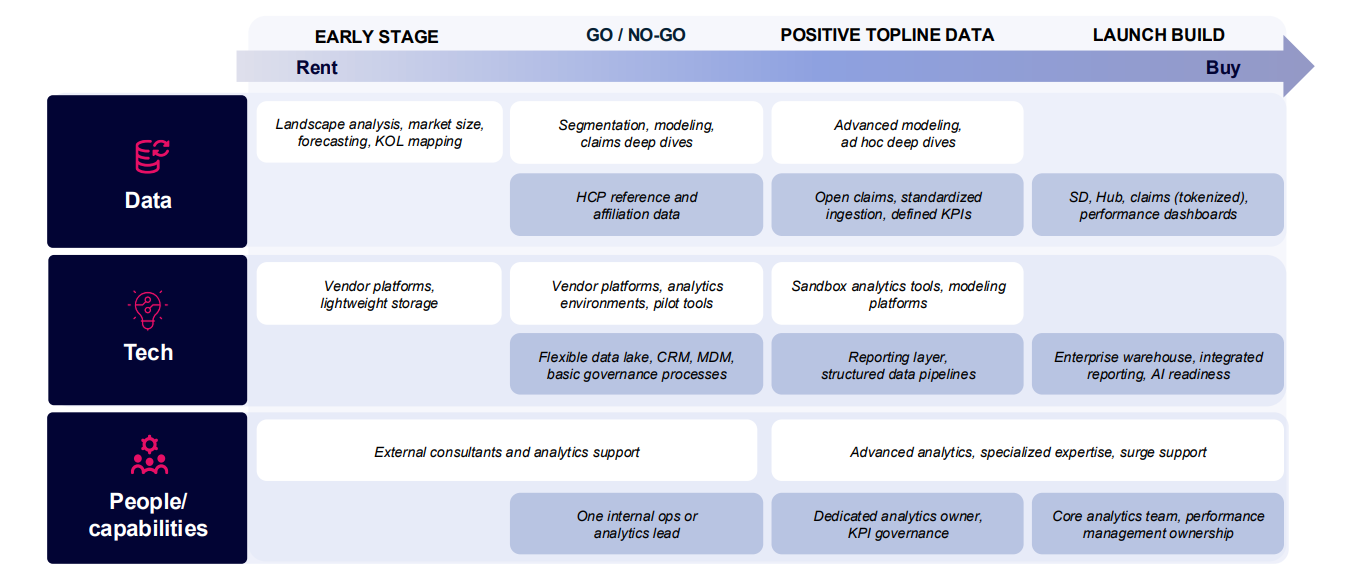
- Launch-ready model: Core data, tech, and capabilities for a successful launch and ongoing operations
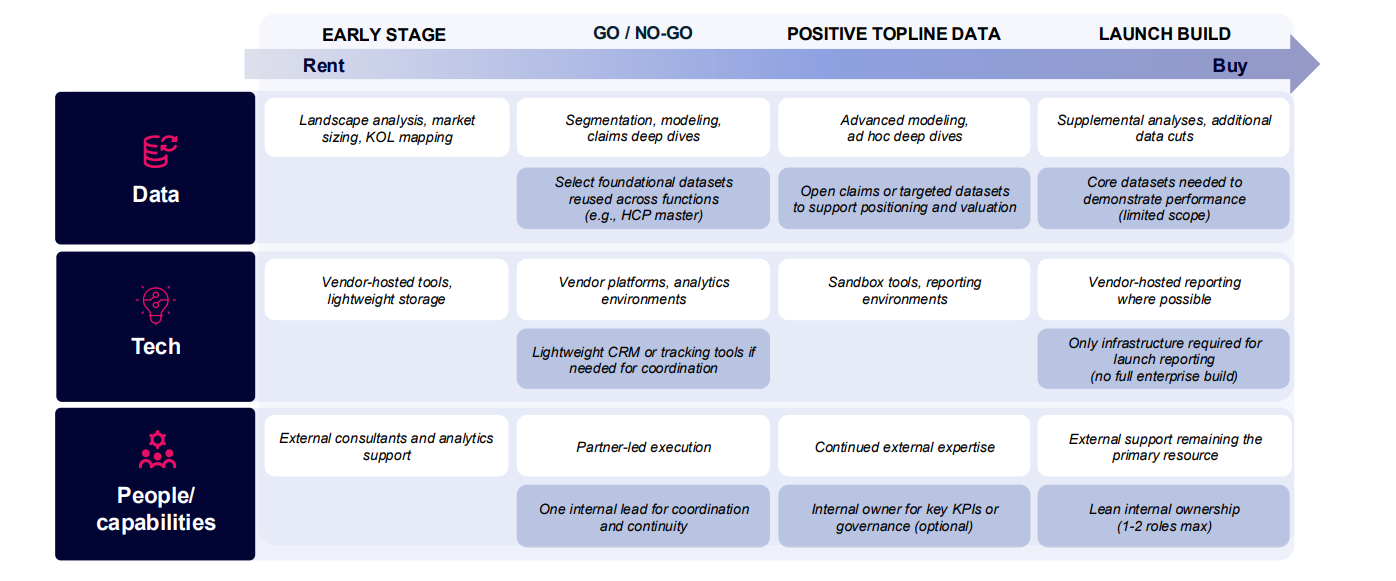
- Partnership or acquisition model: Flexibility and lower commitment, investing only where it supports near-term decisions or asset value
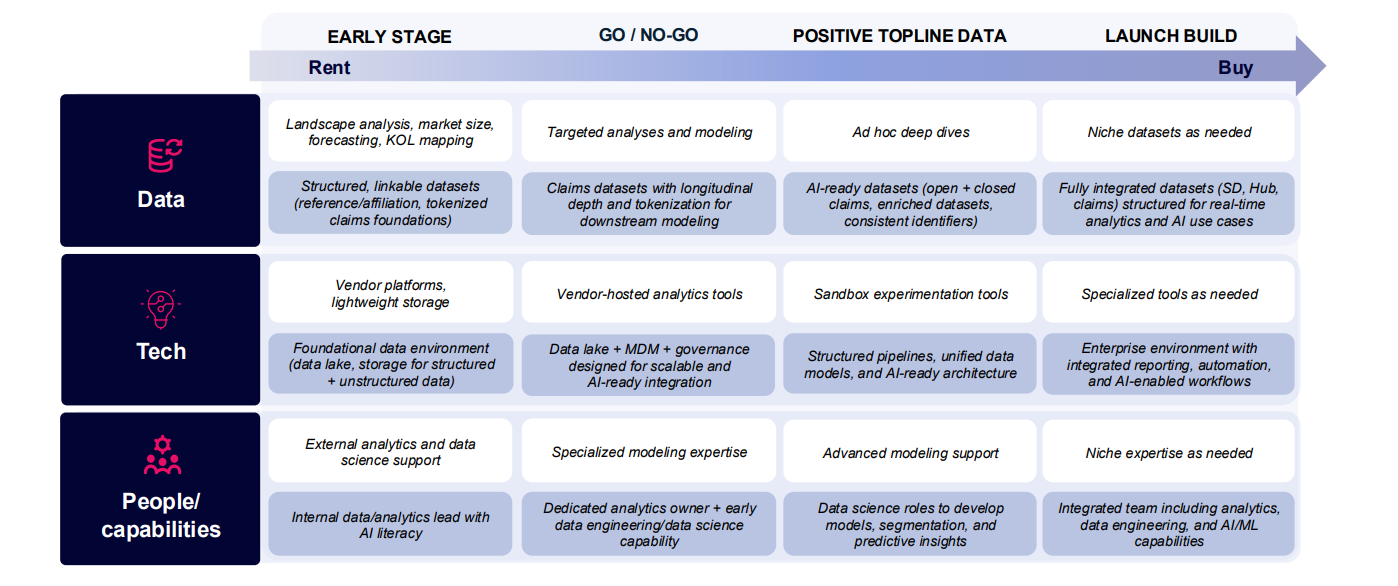
- High-performance model: Early strategic investments to drive differentiated launch performance
LAUNCH-READY ROADMAP EXAMPLE
Committing to a launch-ready operating model
For corporate strategies focused on building to launch and scale, where a balanced shift from early flexibility to durable data and infrastructure will support ongoing operations and repeatable execution
PARTNERSHIP OR ACQUISITION ROADMAP EXAMPLE
Prioritizing flexibility over long-term ownership
For corporate strategies that benefit from delaying infrastructure and internal builds and investing only where it strengthens the asset story or supports near-term decisions
HIGH-PERFORMANCE LAUNCH ROADMAP EXAMPLE
Investing to elevate launch performance
For corporate strategies focused on differentiation and performance, where investing early in AI-enabled data, infrastructure, and capabilities will enable faster insight generation and automation
REACHING THE RIGHT BALANCE
Flex early and commit when it matters
The right data investment roadmap depends on your business needs and corporate strategy, shaping how much you build, what you own, and when you commit.
-
Find the model that fits your needs and strategy.
Rent or buy based on your stage, priorities, and whether you are optimizing to have a minimal viable footprint or for long-term repeatability and scale.
-
Build a cross-functional roadmap aligned to launch milestones.
Visualize your model to simplify decision-making and ensure investments reflect real needs at that time point rather than the full set of available vendor options.
-
Make your data work across decisions and functions.
Consider whether a single dataset or existing data can support multiple business decisions across functions before adding new or duplicate sources.
-
Expect your approach to evolve over time.
Review your decisions against your roadmap to determine whether to shift from flexible, point-in-time solutions to durable datasets, infrastructure, and ownership.