


As you stand up your commercial data ecosystem, decisions about what to buy, build, or buy+build (hybrid approach) will directly impact launch readiness and long-term scalability.
Use this quick guide to learn about:
-
Market pressures affecting these decisions
-
How your peers approach this decision for different data and technology types
-
Common missteps and how to avoid them
-
Core trade-offs with each approach
-
How to make the right call
MARKET PRESSURES
Launch pressure complicates early infrastructure decisions
What’s making it harder now:
- First-launch timelines leave little room for rework.
- Early infrastructure decisions are costly and disruptive to unwind.
- Lean teams must reconcile commercial, medical, and access data needs.
- Vendor and AI proliferation increase choice and integration complexity.
WHAT PEERS ARE DOING
CRMs are bought, data is built, and AI is a hybrid of buy and build
Our Commercialization That Works research shows how industry leaders are currently approaching buy vs build vs hybrid (combination of build and buy) decisions. Teams frequently balance trade-offs around budget, integration, speed to value, and flexibility in their purchasing decisions.
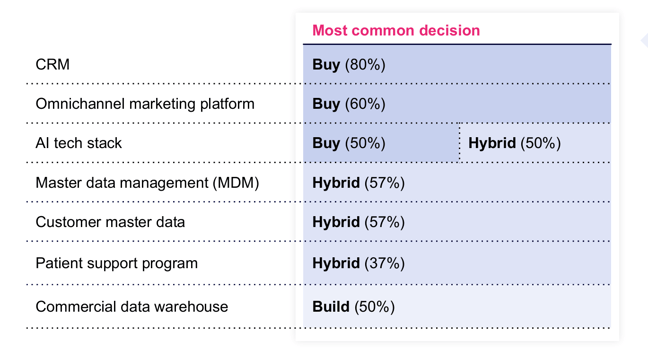
Source: Commercialization That Works research: What do you think is the best approach to establish and maintain the following for commercialization success? (choose one per category);n=30 data and analytics respondents
Key takeaways:
-
Established technologies like CRMs are usually bought because commercial solutions are mature and configurable.
-
Emerging areas, such as AI tech stacks, tend to skew toward buy or hybrid, most often due to limited internal expertise.
-
Build or hybrid approaches are often used when off-the-shelf options don’t fully fit the organization’s needs.
COMMON MISSTEPS
6 infrastructure decisions that create downstream launch risk
|
Common misstep |
What breaks as a result |
Recommended actions to |
|
Underestimating integration effort |
You go live quickly, but connecting systems becomes the real work and teams spend time reconciling numbers instead of using them. |
- Map data flows and ownership before vendor selection - Evaluate the integration model (aggregator vs. custom) early - Require vendor transparency on APIs, identifiers, and refresh cadence |
|
Lacking cross-functional alignment |
Systems technically work but don’t reflect how teams actually operate, slowing adoption and requiring workarounds. |
- Align system and data decisions to clear business use cases |
|
Prioritizing customization over scalability |
The system’s tight tailoring to current workflows makes expansion, automation, or new capabilities more difficult. |
- Define what truly differentiates vs. what can be standardized - Design with modular components - Stress-test decisions against future use cases (new indication, geography, channel) |
|
Using a hybrid model without a clear architecture |
The mix of tools technically works, but no one is fully accountable for how they work together. |
- Define the target architecture before selecting components - Clarify which capabilities you will own vs. outsource and why - Assign a single accountability owner for cross-system integration |
|
Assuming decisions only need to solve for launch |
The solution works in the short term but doesn’t fit when an indication or new brand is added. |
- Design for a longer horizon - Avoid asset-specific architecture where possible - Build with components that can scale or be repurposed |
|
Misunderstanding the time and effort to stand up infrastructure |
Implementation takes longer than expected, and launch year is spent fixing systems instead of driving performance. |
- Map the implementation timeline and dependencies to milestones - Account for development, testing, rework, and stabilization time for each major step in the process - Separate “must be live at launch” from “can phase in later” |
CORE TRADE-OFFS
Evaluating cost, integration, and long-term scalability
Each path (buy, build, or hybrid) trades speed for control in different ways.
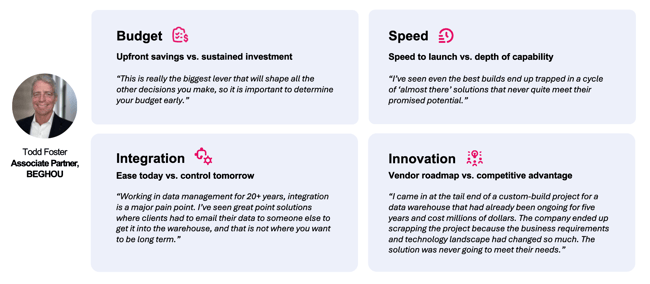
How the trade-offs play out in practice
|
Buy |
Build |
Hybrid |
|
|
Budget |
- Lower upfront investment - Predictable licensing costs - Vendor pricing model driving long-term spend |
- Higher upfront development cost - Ongoing maintenance and staffing required - Greater long-term cost control if sustained internally |
- Balanced capital allocation - Targeted internal investment where differentiation matters - Clear governance needed to avoid duplicated spend |
|
Speed |
- Faster deployment - Proven workflows - Lower near-term execution risk - Data security and compliance built in |
- Longer time to usable capability - Testing and stabilization required - Higher pre-launch execution risk |
- Benefits from buying launch-critical components - Ability to build differentiated layers over time - Requires disciplined sequencing |
|
Integration |
- Pre-built connectors (varies by vendor) - Integration still required across systems - Limited visibility into and control over underlying logic |
- Full control of data model and logic - Heavy integration lift internally - Governance responsibility remaining internal |
- Ability to internally own core data backbone and layer on select tools - Clear integration owner required to avoid fragmentation |
|
Innovation |
- Ability to leverage vendor roadmap and R&D - Dependent on vendor innovation priorities (including scalability) |
- Full flexibility and customization - Innovation funded and staffed internally |
- Vendor-driven innovation for mature areas - Internal ownership where competitive advantage matters - Requiring long-term architectural vision |
MAKING THE RIGHT CALL
Anchor to a launch-aligned roadmap
Under launch pressure, it’s tempting to optimize for speed or control. The better approach is to focus on converting your commercial strategy into actionable, investible activities and tie your investment decisions to a clear roadmap.
- Design for a long horizon while keeping an eye on immediate needs. Your architecture should support growth, but it's important to separate what must be ready on day one from what can scale post-launch.
- Align systems decisions to business needs. Shape infrastructure choices around cross-functional stakeholder priorities and end user workflows.
- Own your data backbone. Buy where differentiation doesn’t matter. Mature workflow tools can be bought, but foundational data layers require intention.
- Be explicit about ownership. Hybrid works well when accountability for integration and governance is clear.
- Stabilize before you scale. Don’t layer advanced capabilities (AI, automation, orchestration) before core systems are stable.