


Results of a new survey of pharma reps suggest that, despite much investment in field force enablement, familiar gaps remain along the HQ-to-rep intel chain.
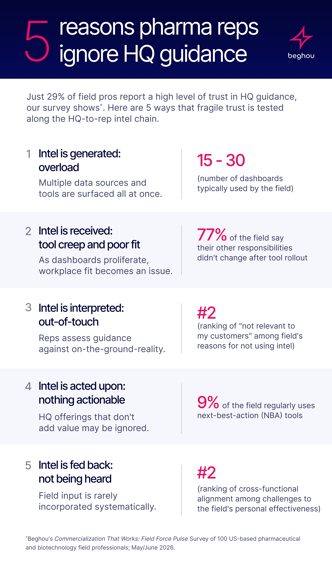
Biopharma field reps have a complicated relationship with headquarters (HQ)-derived intel: They’re dependent on it but skeptical of what it delivers.
On one hand, reps can encounter 15 to 30 dashboards in the course of their work, supplementing customer relationship management (CRM) systems. On the other, the HQ-derived insights making their way into these reports don’t always sit well with the field teams for whom they’re intended.
And therein lies a disconnect, says Gaurav Jha, Associate Partner, Beghou, who works with mid-sized and large pharma clients on commercial analytics. “On the dashboard side, HQ wants to show more and more data to the rep to prepare for their next clinician interaction,” but those dashboards do not always deliver what the field needs.
A fragile trust
Indeed, a majority of biopharma field managers and reps (71%) say they have only low-to-moderate trust this guidance, according to findings from Beghou’s Commercialization That Works: Field Force Pulse Survey of 100 U.S.-based pharma and biopharma field professionals across sales, medical, and account-focused roles.
That lack of trust becomes especially fragile when the data or analytics conflict with the rep’s own judgment. The primary reason cited for non-use of AI-generated insights or next-best-action (NBA) guidance was reliance on personal experience, according to the same study, and 72% said they trust their own field judgment over centralized recommendations in most situations.
Five complaints we’re hearing from reps explain the disconnects between HQ and the field.
01: Intel is generated: information overload
In her analytics work with pharma clients, Beghou's Taylor Mikkola, Manager, says she's seen a pattern emerge: HQ wants to "take advantage of everything that they have and really get that in front of the field," but when it all lands at once, "it just feels more administrative or overwhelming." The work, she says, is turning that load into "more of a resource than an admin burden."
In fact, respondents in Beghou’s Field Force Pulse Survey cited information overload as one of their top three challenges to overall effectiveness.
Reps also report seeing the same metric with conflicting values in different dashboards. That creates confusion and lack of trust in data, adds Jha.
All of which can contribute to making intel feel less like an actionable resource.
02: Intel is received: tool creep and poor fit
Compounding the deluge of information, new reports are often disconnected from the reporting suite as a whole, Mikkola adds. This can occur when new contracts are established for additional capabilities without evaluating how they integrate with the existing infrastructure or fit within reps’ workflows.
As a result, reps must often go to multiple tools to complete a single action.
An anecdotal proof point: Mikkola observes that even when dashboards exist, reps still download data to Excel and filter it manually, signaling that the reports do not provide the views the field needs.
According to the survey, 77% of field professionals said their other responsibilities didn't change after tool rollout, and 69% said tools need to fit naturally into their workflow or they'll stop using them quickly.
03: Intel is interpreted: guidance is out-of-touch
Our survey detected a greater openness to centralized recommendations that reflect real customer needs.
But the results also identify a need for call plans to be more dynamic: Intel that's "not relevant to my customers" ranked second among the field's reasons for disuse.
And the problem of guidance being out-of-touch is not just related to intel, like segmentation, outliving its shelf life but also to rep feedback not being taken into account for ongoing segmentation maintenance.
For instance, what if new indications or competitors arrive in a market? What if a large health system becomes “no-see?” What if a rep notes, "This HCP is not a relevant target for me?" Plans need to reflect that.
04: Intel is acted upon: there's nothing actionable
Once they interpret the intel, reps will either act on it or not. This is the stage where adoption issues may surface.
For reps to perceive intel as valuable rather than noise, it must add a new, actionable insight rather than restate what’s already known, says Mikkola. An example would be a quick way for the rep to log into their CRM and see that a physician has had a decline in prescribing and has not been visited in a week, rather than simply listing call counts and prescription totals.
Jha adds a related issue: NBA offerings are “a black box right now,” in that they often lack a rationale for their recommendations.
Against that backdrop, low adoption is notable: Only 9% of field professionals are regularly using NBA tools, findings show, and less than half (48%) are regularly using AI-generated insights like call prep or message suggestions.
05: Intel is fed back: the field is not being heard
Feedback loops are another factor undermining confidence in HQ-derived guidance. Reps often feel their expertise and feedback disappear into a void, with no visible effect on platform design, dashboard layout, plan updates, or NBA logic.
Echoing this frustration, the second-biggest challenge to personal effectiveness, as per the survey ranking, was internal coordination and cross-functional alignment.
A core requirement is a reliable mechanism to collect and act on field input before a refreshed plan is finalized, ensuring reps see their observations reflected, as well as ensuring a consistent view of customers across platforms.
Consider a case where a rep is notified that it might be a good time to call on a physician, yet the rep has just seen that physician (and knows the clinician interacted with a manufacturer’s website or other resource). Internal teams must understand why the rep dismisses the alert or risk compounding the field’s sense of disengagement.
How to bridge the gaps
Mikkola and Jha say the following recommendations are being practiced by leading teams to provide the tools and insights reps need, as well as shore up field confidence across the aforementioned areas:
- First, take a step back and audit the tools currently in play for the field, across all platforms, and consider rep feedback on what they find useful and when.
- Map out how those tools can best be integrated, connected, or consolidated, where possible.
- Ensure there’s a single source of truth or underlying data backbone feeding all of those tools, so reps get consistency, both in the insights and the view of customers.
- Include only the highest priority KPIs, measuring reps’ accomplishments or actions taken.
- Establish a way for the field to give feedback before each new quarterly call plan is finalized, so reps see it incorporated across tools and future insights.
The net effect of these recommendations is that reps will spend less time as data administrators and more time doing what they're good at: applying their sales acumen to their customer base, informed by the HQ-derived tools rather than burdened by them.