


What the research showed
AI adoption has a strong foundation of employee interest
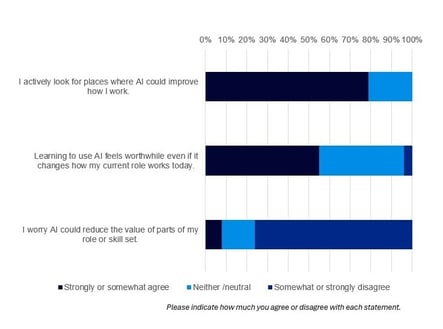
79% reported that they seek places for AI to improve their work, while only 8% were worried that AI could reduce the value of their role or skills.
This combination of high interest and low fear suggests the barrier to AI adoption is structural rather than willingness.
The opportunity: convert that interest and experimentation into supported, repeatable ways of working.
Access survey methodology, executive summary and full report here.
Barriers clustered around clarity and trust
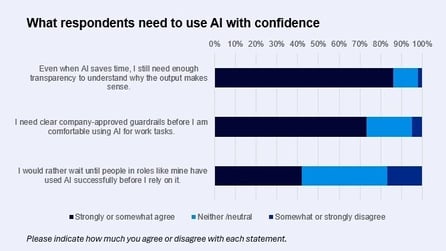
The findings indicate that confidence declines as the stakes rise: 67% were more comfortable using AI for drafting and synthesis than for recommendations that could materially affect business decisions. This underscores the need for greater transparency and clearer rules for compliant use before AI can expand into materially supporting decision-making.
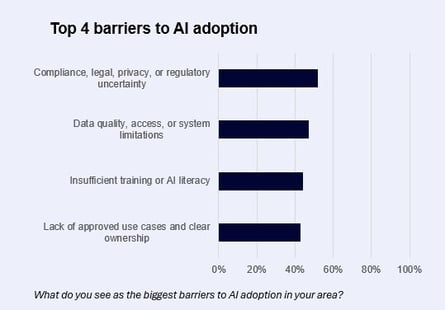
Sustaining use will require life sciences organizations to address barriers ranging from governance and data concerns to unclear ownership and limited training.
Workflow fit was a recurring theme
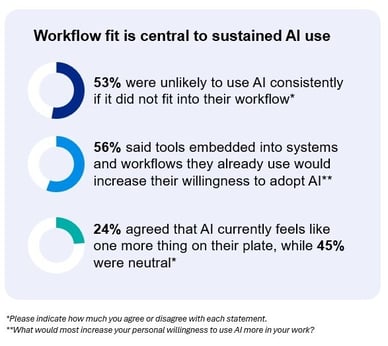
With 24% saying AI feels like one more thing on their plate and another 45% neutral, some respondents may still be unsure whether AI will ease their workload or add to it.
Involving users in tool design can help ensure AI supports actual workflows and feels useful in practice.
The opportunity: embed AI into the tools and workflows people already use, so adoption feels like an extension of what they're doing already.
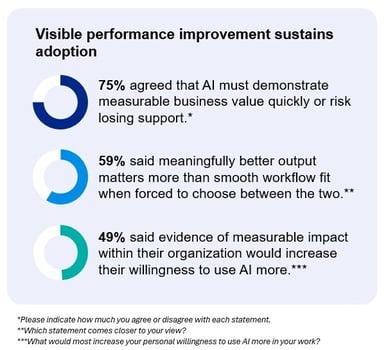
Respondents were clear that AI has to prove its value
People need to see that AI produces better outputs and delivers measurable value before it earns a lasting place in how they work.
In other words, respondents do not want ease at the expense of value. They want AI to be usable and contribute meaningfully to what they're doing day to day.
The opportunity: lead with visible, measurable wins to build trust and encourage continued use.
A practical approach to what comes next
Different mindsets open the door for more focused support
The research reinforced that biopharma and pharma professionals encounter AI with different levels of experience, curiosity, confidence, trust, and required support:
-
Some are already experimenting but lack the structure to apply AI responsibly.
-
Others see its potential but need evidence that it will improve performance.
-
Some are willing to learn but do not know where to begin.
-
Still others simply have too many competing priorities for AI to become part of their work routine.
Contrary to what many think, these differences do not align neatly with role, seniority, or generation.Because multiple adoption mindsets may exist within the same function or team, a single adoption strategy is unlikely to work for everyone.
Commercialization teams already have a model for this:
HCP segmentation and omnichannel orchestration, where engagement strategies are tailored to drive awareness and adoption of new therapies across specialties, geographies, and readiness levels. Applying that same logic internally shifts the focus from rolling out AI to treating AI adoption as an audience to understand.
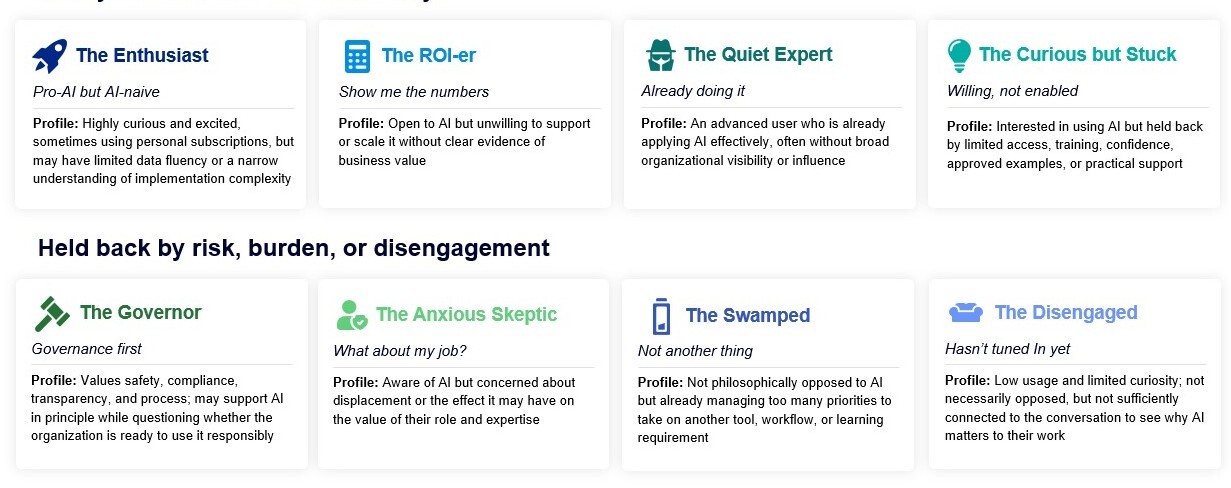
Similarly, we designed the survey to identify behavioral personas that represent the different AI starting points. Eight personas emerged from the findings.
Segmenting AI adoption as you would HCPs and patients
The eight personas provide a broad view of how individuals within an organization may approach AI.
"Market to your team" to support adoption
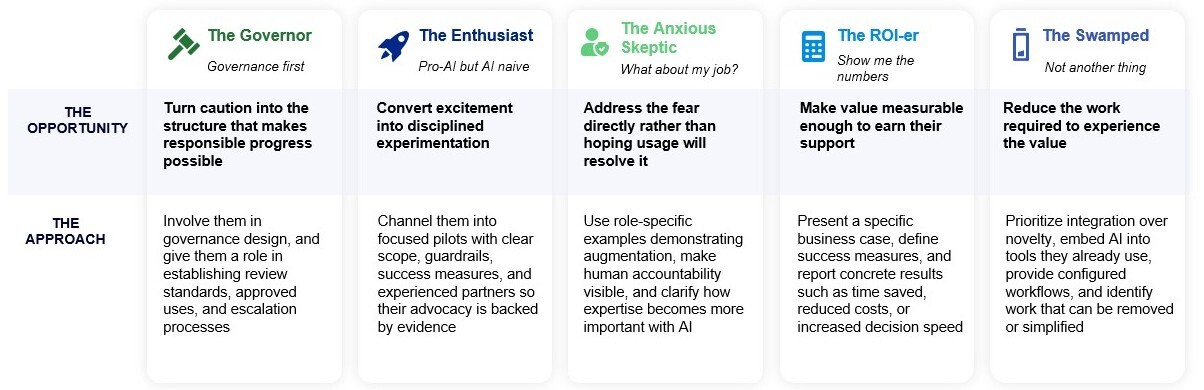
Just as commercial teams tailor messaging and channels to different HCP and patient segments, driving AI adoption can be accomplished by matching the right message, evidence, and support to each persona.
Although all eight personas on the previous page help understand the overall segmentation, when time, funding, and change management capacity are limited, it's important to focus resources where they'll have the greatest impact.
The five GEARS personas below represent those higher-impact opportunities.
Five moves to go from experimentation to adoption
-
Take a marketing approach: Segment employees by adoption mindset, then combine role-specific learning with tailored support, making sure training is ongoing, practical, and relevant
-
Set the guardrails: Give teams clear, role-relevant guidance on where AI can be used, what information can be entered, and where human review is required
-
Build trust: Make the source data, output logic, review processes, and accountability visible, especially where AI informs high-impact decisions
-
Embed AI into actual workflows: Co-design with the people who'll use it, reduce steps, eliminate repetitive work, and fit within systems already in use
-
Prove value through focused use cases: Begin with a limited number of meaningful business problems, define success measures, and use results to determine where to scale