


Beghou research, presented at this year’s PMSA, uncovered the attitudes and behaviors shaping adoption—or avoidance—of AI on biopharma commercialization teams.
By the Numbers
What researchers learned about AI adoption.
- 4 myths busted:
- Enthusiasm equates to usage. ️
- A person’s department matters more than their mindset.
- Younger execs outpace their older counterparts.
- More training is the solution.
- 2 counterintuitive findings:
- When it comes to AI adoption, the biggest barriers are cultural and organizational, not technological.
- There are 8 AI adoption personas, 5 of which are influenceable, showing why a one-size-fits-all rollout is unlikely to work.
- 1 takeaway for commercialization execs:
- Tailoring change management to employee persona is more likely to yield AI's business value.
Gen AI has turbocharged adoption among biopharma commercial teams. But it’s the analytics/IT group that’s leading the AI embrace, while their counterparts in sales and marketing lag.
The preceding narrative, however, is more tall tale than truism. According to the AI Enablement survey, part of Beghou's Commercialization That Works research, no single functional area can be characterized as more stoked for, or skeptical of, the technology’s hyper-rapid advance.
.png?width=649&height=365&name=DocImage_1%20(1).png)
“Within each function are a lot of different mindsets,” observed study co-leader Brett Ramos, formerly Director of AI and Omnichannel Advanced Analytics at Acadia Pharmaceuticals. "Adoption is not driven by the department so much as the individual.”
AI myths that don't survive the data
This wasn’t the only piece of AI conventional wisdom to be turned on its head by Ramos and Beghou Partner Nicole Ventrone based on their survey findings, which the pair presented at the Pharmaceutical Management Sciences Association (PMSA) meeting in May.
For instance, the two also explode the notion that enthusiasm equates with usage. While some may be enthusiastically tinkering with their CoPilot, ChatGPT, or Claude subscription, that doesn’t necessarily make them power users.
Actually, according to the research, “Someone might have a paid subscription to an LLM,” said Ramos, “but they don't really know much about AI or how to utilize it in ways commercial organizations can scale.”
In the course of their research, two more myths were overturned, that older employees would be more fearful of using AI than younger ones and that more training will solve AI adoption. Research showed there are quiet experts in every age bracket, and that more training or education shouldn’t be considered the default cure for sluggish uptake.
What was their reason for putting the above industry tropes to the test? It wasn’t merely their fandom for the cable show MythBusters (both Ventrone and Ramos are admirers of the iconic series) or a desire to buck convention.
Their motivation stemmed from the observation that AI adoption “has been a mixed bag,” explained Ramos. "There are aspects that have been adopted, things that don't get adopted—what are the drivers of that?”
To find out, Beghou conducted a survey of 100 biopharma commercialization leaders to understand their views on AI readiness in life sciences. The survey spanned different roles, from finance and IT to sales, marketing, and analytics.
Personas explain why adoption varies
Those data were compiled into a behavioral segmentation framework categorizing individuals by their orientation toward the technology. That’s designed to give organizations the opportunity to create targeted communication and change-management strategies.
“We've segmented many of our end customers, like HCPs and other stakeholders,” Ramos explained, “but have we done that segmentation internally focused on the commercial organization? Where are the people that are driving AI across that organization, and what are the archetypes or characteristics of people?”
Ramos and Ventrone identified eight different personas, or archetypes, of which five were deemed to be influenceable (see table). These personas were characterized by different attitudes vis-a-vis respondents' enthusiasm, skepticism, data fluency, and decision-making criteria.
.png?width=667&height=375&name=DocImage_2%20(1).png)
Their thesis: Armed with a deeper understanding of those personas, including their barriers to AI use, companies can plan AI’s implementation in a way that “meets people where they are,” addresses their real-world needs, and integrates into existing workflows.
These personas also highlight that a one-size-fits-all approach to AI implementation is unlikely to work across the organization. By segmenting teams into these personas, companies can begin to personalize their AI adoption journey.
Change management is the real challenge
Lack of attention to these tenets of change management has been an AI fault line for companies in the past. MIT’s AI study published in mid-2025 showed that 95% of enterprise AI pilots fail, largely due to “brittle workflows, lack of contextual learning, and misalignment with day-to-day operations.”
“The problem isn't technology,” said Ramos. “Yes, AI is not perfect, right? There are many things that are still left to be done on that front. But the real problem right now is change management. It's getting people to change the way that they've done things.”
How to leverage that deeper understanding of colleagues to build a change management and adoption plan?
'Opportunity to connect’
First, said Ventrone, it’s important to note that, per survey results, one-third of the study population already integrates AI into how they work, another third is experimenting but using it effectively, and another third is either only using it when required or waiting for more proof, training, or approval.
.png?width=669&height=376&name=DocImage_3%20(1).png)
Which of the following best describes your personal approach to AI at work today? n=100 pharma and biopharma professionals (entire cohort)
These findings show “there’s an opportunity there to connect,” she said.
If AI adoption is mainly a cultural issue versus a technical one, then companies would be wise to define a unified AI vision and roadmap that’s attuned for the various personas, their prior experiences, and desired ways of working.
Different personas, different strategies
For instance, “the Governor” archetype maps neatly to survey results showing the No. 1 barrier to AI adoption, unsurprisingly, was compliance. This persona characterizes the compliance-focused person, the one who’s concerned about legal ramifications, the risk that might accrue when AI goes rogue, or if data were shared without guardrails, explained Ventrone.
“They're very risk-averse, and that caution is well-founded,” she said, “but it can also keep them from progressing and adopting AI.”
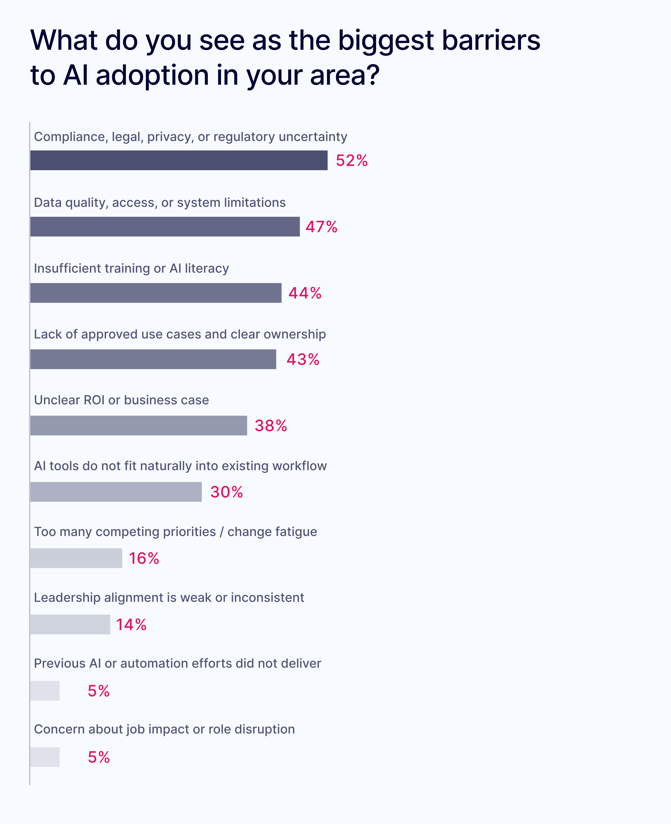
What do you see as the biggest barriers to AI adoption in your area? n=100 pharma and biopharma professionals (entire cohort)
The key for this group? “Address their concerns and really leverage them,” Ventrone suggested. “Really consider governance. Make sure your organization includes [compliance] people in the process so that their voices are being heard and they’re able to provide that insight into how those guardrails should be applied.”
Another persona falls on the opposite end of the spectrum. The “Enthusiast” is the one who’s pro-AI but also AI-naïve.
"This is a particular challenge in the sense that sometimes people who fall into this segment can be so enthusiastic that they might not see some of the cautions around the limitations of AI,” she explained.
People who fall into this persona require a dose of pragmatism—”channel that energy, harness it, but help give them some connection around the realities of what AI can provide,” recommended Ventrone.
Mixed signals slow adoption
It’s very easy to get into a Governor or Enthusiast mindset, or any of the other three, considering AI’s rapid pace of change.
“The Industrial Revolution happened over many years; this is happening over months,” said Ramos. “And mixed into this concept is fear—how is this technology really going to change my job? There is a lack of adoption of something you're afraid of. There's also that aspect of, ‘Man, this is complicated.’”
That complexity can lead to avoidance, a feeling of, “I’ve already got so much on my plate.”
Internal alignment also plays a role. Some organizations are trying to support AI enablement. Their executives say they want to, but at the same time teams lack clear support and guidance on how to use it. That can leave the rank-and-file wondering, "Am I even allowed to? Should I be using this?” said Ramos.
“Maybe there's even some guilt associated with it,” he said. “If you use something for AI, they say, ‘Did you create this with AI?’”
Technology not the biggest hurdle
All of those factors can cause a lack of adoption. On the other hand, data suggest technology isn’t the main hurdle. According to a recent report from Snowflake, AI is working when it gets adopted: In life sciences, the ROI on gen AI is 43% among those who’ve quantified their gains (earning back $1.43 for every dollar invested), and 92% of early adopters (across all industries) report positive returns.
“The problem is, the industry doesn't always adopt AI,” said Ramos.
For commercialization execs, the takeaway is that “one rollout for everyone” isn’t the best approach. What’s more likely to yield AI's business value is to tailor change management to different employee personas.
Utilize the change management suggestions to adapt to the individual segments and archetypes seen within your organization. There’s also a downside to the organization if these particular archetypes are not addressed. See the “GEARS” slide above for the organizational upsides and risks, respectively.
So, whether your organization’s adoption rate is high or low—nearly 35% of survey respondents said they already integrate AI into their work, although that self-rating may be overly generous—the segmentation approach warrants strong consideration.
A deeper understanding of behavioral and attitudinal barriers may help ensure companies reap the benefits of their AI investments.